

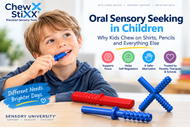
Oral Sensory Seeking in Children: Why Kids Chew on Shirts, Pencils and Everything Else
Posted by Sensory University, Inc. on 21st Sep 2026
Oral Sensory Seeking in Children: Why Kids Chew on Shirts, Pencils and Everything Else
Does your child constantly chew on shirt collars, sleeves, pencils, toys, fingers, blankets or other objects?
You are not alone.
For many children, chewing isn't simply a bad habit that needs to be stopped. Frequent chewing can be connected to oral sensory seeking — a child's desire for additional sensory input through the mouth, jaw, lips and teeth.
Some children chew when they are concentrating. Others chew when they are excited, overwhelmed, tired, anxious or bored. For some children, chewing simply provides the type of sensory input their body is looking for.
Understanding why a child chews is often the first step toward finding a safer and more appropriate alternative.
What Is Oral Sensory Seeking?
Our sensory systems constantly receive information from the world around us.
We feel clothing against our skin, hear sounds, see movement, smell food and sense the position and movement of our bodies.
The mouth is also an extremely sensory-rich part of the body.
Chewing creates pressure through the teeth and jaw while providing tactile input inside the mouth. Because of this combination of sensations, some children actively seek opportunities to bite or chew.
This behavior is often described as oral sensory seeking.
A child who seeks oral sensory input may chew occasionally, or the behavior may happen throughout much of the day.
The important point is that the behavior may be serving a purpose for the child.
Common Signs of Oral Sensory Seeking
Every child is different, but parents, teachers and therapists may notice behaviors such as:
- Chewing shirt collars or sleeves
- Biting hoodie strings
- Chewing pencils or pens
- Putting toys in the mouth
- Chewing fingernails or fingers
- Biting blankets or bedding
- Chewing backpack straps
- Frequently putting non-food objects in the mouth
- Preferring crunchy or chewy foods
- Seeking strong flavors or textures
- Chewing more during schoolwork or homework
- Chewing during stressful or unfamiliar situations
Some children may display only one of these behaviors, while others may seek oral input in several different ways.
Why Does My Child Chew on Everything?
There isn't one universal explanation.
Chewing can happen for many reasons, and more than one may be present at the same time.
1. The Child May Be Seeking Sensory Input
For some children, chewing provides satisfying pressure to the jaw and mouth.
A child may repeatedly seek that sensation in much the same way another child may enjoy bouncing, swinging, squeezing objects or constantly moving.
When this is the case, simply telling the child to "stop chewing" may not address the underlying need.
Providing an appropriate item specifically designed for chewing may be more practical than expecting the need to disappear.
2. Chewing May Occur During Concentration
Have you ever noticed someone chewing gum while studying or working?
Children sometimes show a similar pattern.
A child may begin chewing a pencil, shirt collar or other object while:
- Reading
- Completing homework
- Taking a test
- Using a computer
- Sitting through class
- Listening to instructions
- Working on a difficult task
Parents and teachers may initially view the chewing as a distraction when it may actually appear most often when the child is trying to concentrate.
3. Chewing May Increase During Stress or Overstimulation
Children do not always recognize or communicate stress the way adults do.
Changes in routine, loud environments, crowded classrooms, unfamiliar places or difficult tasks may increase sensory-seeking behaviors.
For some children, this includes chewing.
If chewing suddenly increases, consider what was happening immediately before the behavior started.
Looking for patterns can provide useful clues.
4. Boredom Can Play a Role
Sometimes chewing is simply something to do.
Long car rides, waiting rooms, watching television or sitting through activities that require little physical movement can increase repetitive behaviors.
If chewing primarily happens during these situations, having an appropriate sensory item available may help redirect the behavior.
5. Developmental and Sensory Differences May Contribute
Oral sensory-seeking behaviors are commonly discussed by occupational therapists working with children who have sensory processing differences.
Chewing can also occur in children with autism, ADHD and other developmental differences.
However, chewing by itself does not diagnose autism, ADHD or a sensory processing condition.
Many children without these diagnoses chew things as well.
When chewing is frequent, destructive, unsafe or interfering with everyday activities, parents may want to discuss it with a pediatrician, occupational therapist, speech-language pathologist or another qualified professional.
Why Do Children Chew Their Shirts?
Shirt chewing is one of the most common concerns parents report.
There are several practical reasons clothing becomes a favorite chewing target.
A shirt is:
- Always available
- Easy to reach
- Soft against the mouth
- Familiar
- Convenient to chew without using the hands
Unfortunately, frequent shirt chewing can lead to stretched collars, holes, wet clothing and repeated clothing replacement.
If a child is chewing shirts because they are seeking oral input, repeatedly telling them not to chew the shirt may simply cause the behavior to move to another object.
A purpose-designed sensory chew tool gives the child something intended specifically for that activity.
Why Do Children Chew Pencils at School?
Pencils are another extremely common chewing target.
They're already in the child's hand during periods requiring concentration, which makes them particularly convenient.
The problem is that pencils and pens were never designed to function as chew tools.
Repeated chewing can damage them and may create rough edges or small pieces.
For children who frequently chew while completing schoolwork, a chewable pencil topper or another classroom-friendly oral sensory tool can provide a more appropriate option.
What Is a Sensory Chew?
A sensory chew or oral motor chew tool is an item designed specifically to provide a chewable surface for individuals who seek oral sensory input.
Unlike pencils, clothing, toys and household objects, sensory chew tools are intentionally designed for chewing.
They are available in different:
- Shapes
- Sizes
- Textures
- Thicknesses
- Resistance levels
- Flavors
- Handheld designs
- Wearable designs
That variety matters because sensory preferences can be highly individual.
One child may prefer a smooth, softer chewing surface, while another strongly prefers ridges, bumps or increased resistance.
Not Every Child Needs the Same Chew
One of the biggest mistakes when selecting a sensory chew is assuming every chew works equally well for every child.
Think about how the child currently chews.
Light Chewers
A light chewer may:
- Gently mouth objects
- Chew occasionally
- Prefer softer resistance
- Rarely damage the objects being chewed
A lighter or hollow sensory chew may be appropriate for this type of user.
Moderate Chewers
Moderate chewers may chew throughout the day and apply noticeably more pressure.
Texture and durability become increasingly important.
A multi-textured oral motor chew can provide different surfaces for the child to explore without constantly changing products.
Heavy or Aggressive Chewers
Some children can damage standard chew tools quickly.
For these individuals, durability needs to be a major consideration.
Chew Stixx® Tough Bar was designed for users who require greater chewing resistance and durability.
No chew product is indestructible, however. Every oral sensory product should be inspected regularly and replaced when signs of significant damage or wear appear.
Texture Can Matter as Much as Chewing Strength
Chewing is only part of the sensory experience.
The tongue, gums and inside of the mouth are extremely sensitive to texture.
This is one reason Chew Stixx products incorporate different textures, including ridges, bumps and other tactile surfaces.
Some children strongly prefer one texture over another.
Pay attention to what the child already chooses.
Does the child seek:
- Smooth objects?
- Firm objects?
- Bumpy surfaces?
- Ridges?
- Hollow objects?
- Thick objects?
- Thin objects?
Those preferences can help guide the selection of an oral sensory tool.
Flavor Can Add Another Sensory Dimension
Some individuals are particularly motivated by taste and smell.
Chew Stixx® Original is available in multiple flavor options in addition to an unflavored version, allowing families and professionals to consider flavor preference along with texture and chewing resistance.
For children who do not want flavor, plain options remain available.
The goal is not to make every chew identical. It is to provide choices because sensory preferences vary significantly from one person to another.
Oral Sensory Tools at School
School can be one of the most important environments for managing sensory chewing.
Children may spend many hours each day in a classroom where they are expected to sit, concentrate, listen and complete tasks.
Common chewing targets at school include:
- Pencils
- Erasers
- Shirt collars
- Hoodie strings
- Fingers
- Classroom supplies
An appropriate sensory chew can sometimes be incorporated into a child's classroom routine.
Depending on the child's needs, options might include:
- A chewable pencil topper
- A handheld chew
- A wearable oral sensory tool
- A chew kept inside a desk or pencil case
Parents should communicate with teachers and, when appropriate, occupational therapists or other members of the child's educational team.
Sensory Chews for Autism
Parents frequently search for chews for autism because repetitive chewing and oral sensory seeking can occur in autistic children.
An oral sensory tool may provide an alternative when a child repeatedly chews objects that were not designed to be placed in the mouth.
However, autistic children have widely different sensory profiles.
A product that works extremely well for one child may not appeal to another.
Rather than choosing a product based only on a diagnosis, consider the individual's:
- Chewing strength
- Preferred texture
- Preferred shape
- Flavor preference
- Age
- Environment
- Ability to hold or carry the chew
The individual's sensory preferences should help guide the selection.
Sensory Chews and ADHD
Children with ADHD may also chew pencils, clothing, fingers or other objects.
In some cases, the behavior occurs during activities requiring sustained attention.
Again, chewing alone does not indicate ADHD.
For a child already diagnosed with ADHD who also demonstrates oral sensory-seeking behavior, an appropriate chew tool may be one component of a broader strategy developed by the child's family, teachers and healthcare professionals.
How to Redirect Inappropriate Chewing
The goal does not necessarily have to be simply:
"Stop chewing."
A more practical goal may be:
Redirect chewing from objects that aren't meant to be chewed toward something specifically designed for that purpose.
For example:
Instead of chewing a shirt: offer an oral sensory chew.
Instead of chewing pencils: consider a chewable pencil topper.
Instead of chewing random household items: keep an appropriate chew tool nearby.
Instead of repeatedly correcting the child: teach which item is appropriate to chew.
This approach recognizes that the child may still want the sensory input while changing where that input comes from.
Watch for Patterns
Parents can learn a tremendous amount by observing when chewing occurs.
For several days, consider:
What was the child doing?
Where were they?
What were they chewing?
What happened immediately before the chewing started?
Was the child tired, excited, concentrating, frustrated or overwhelmed?
You may begin to notice a pattern.
Perhaps chewing happens almost exclusively during homework.
Maybe it increases in loud environments.
Maybe it occurs during long car rides.
Maybe the child's shirt collar is soaked by the end of every school day.
Those patterns can help parents and professionals determine when an alternative chew is most likely to be useful.
When Should Parents Seek Professional Advice?
Occasional chewing is not unusual.
Professional advice may be appropriate when chewing:
- Suddenly increases without an obvious explanation
- Causes injuries to the mouth
- Damages teeth
- Creates a choking risk
- Involves swallowing non-food objects
- Interferes significantly with eating
- Interferes with school or daily activities
- Continues despite appropriate alternatives
- Is accompanied by other developmental or feeding concerns
A pediatrician or dentist can help rule out medical or dental causes.
Occupational therapists may evaluate sensory patterns and how they affect everyday activities.
Speech-language pathologists with appropriate training may also address certain feeding and oral-motor concerns.
If a child is actually eating or swallowing non-food substances, rather than simply chewing them, that should be discussed with a healthcare professional.
Choosing the Right Chew Stixx
Chew Stixx® offers oral sensory products designed around different sensory preferences and chewing styles.
Chew Stixx Original
The original multi-textured oral motor chew provides several tactile surfaces in one handheld tool and is available in multiple flavors.
Chew Stixx Junior
A lighter, hollow option for children who prefer less resistance.
Chew Stixx Tough Bar
Designed for individuals who require greater chewing resistance and durability.
Chew Stixx Pencil Toppers
A convenient option for children who frequently chew pencils during schoolwork.
Chew Lolli
A handheld oral sensory tool incorporating multiple tactile surfaces for individuals who enjoy varied textures.
Grip Stixx
Designed with an easy-to-hold shape and textured chewing surfaces.
The best product is the one that matches the individual's sensory preferences, chewing strength and daily environment.
Safety Matters
Any product that is repeatedly chewed should be inspected regularly.
Before use:
- Look for tears
- Check for cracks
- Examine heavily worn areas
- Make sure no pieces are separating
- Replace damaged products
Always follow the age recommendations and safety instructions supplied with the individual product.
Adult supervision may be appropriate depending on the child's age, development and chewing behavior.
And remember:
No chew tool should be considered indestructible.
Frequently Asked Questions About Oral Sensory Seeking
Why does my child chew on everything?
Children may chew objects for several reasons, including sensory seeking, concentration, stress, boredom or habit. Persistent chewing does not automatically indicate a developmental disorder.
Is chewing on shirts a sensory issue?
It can be. Some children chew clothing because the pressure and oral sensation are satisfying. Other children may chew clothing from habit, boredom or stress.
What can I give my child instead of chewing a shirt?
A purpose-designed sensory chew provides an alternative to chewing clothing, pencils, toys or other objects that were not designed for repeated chewing.
Why does my child chew pencils?
Pencil chewing frequently occurs during schoolwork or activities requiring concentration. Because a pencil is already in the child's hand, it becomes a convenient object to chew.
Are sensory chews only for autistic children?
No. Oral sensory tools may be used by children and adults with many different sensory needs. A person does not need an autism diagnosis to use an appropriate chewing alternative.
How do I choose a sensory chew?
Consider chewing strength, preferred texture, shape, size, flavor preference, age and where the product will be used.
How often should a chew tool be replaced?
There is no single replacement schedule because chewing intensity varies. Inspect the product frequently and replace it when it becomes significantly worn or damaged.
Understanding the Need Changes the Approach
A child chewing through another shirt collar can be frustrating.
So can destroyed pencils, damaged toys and constantly reminding a child to take something out of their mouth.
But looking beyond the behavior itself can change the conversation.
Instead of asking only:
"How do I make my child stop chewing?"
It may be more useful to ask:
"Why is my child seeking this sensation, and what can I offer instead?"
For children who seek oral sensory input, providing an appropriate chew tool can help redirect chewing away from clothing, pencils, fingers and household objects.
Chew Stixx® was created around that idea: giving children and adults purposeful oral sensory options in different shapes, textures, strengths and flavors.
Because when you understand what the child is seeking, you have a much better chance of finding the right solution.